0844 5555 171




Why Data Centre ACU Filters. Do Not Filter Dust at 0.5 and 1.0µm. In modern data halls, Air Conditioning Units (ACUs) — whether CRAC or CRAH systems — play a vital role in cooling and humidity control.
However, when it comes to fine airborne particles such as 0.5 and 1.0 micron (µm) dust, standard ACU filters simply aren’t designed to catch them — especially when economised (fresh) air is introduced for energy efficiency.
In this post, Stephen Yates of IT Cleaning Ltd explain why this happens and how data hall managers can minimise dust contamination.
What ACU Filters Are Designed to Do
The filters in an ACU are there to protect the system’s internal components — not to deliver cleanroom-grade air. Their job is to stop large dust, fibres, and debris from clogging fans and coils.
Most ACUs in data halls are fitted with G4 or M5 filters, which efficiently capture coarse particles but allow smaller ones to pass through.
| Filter Class | ISO Rating | Typical Efficiency | Target Particle Size |
| G4 | ISO Coarse | >90% @ ≥10 µm | Large dust & fibres |
| M5 | ePM10 | 40–60% @ ≥3 µm | Medium dust |
| F9 | ePM1 | 90–95% @ ≥0.3 µm | Fine dust (PM1) |
| HEPA | H13 | ≥99.97% @ ≥0.3 µm | Micro dust, bacteria, smoke |
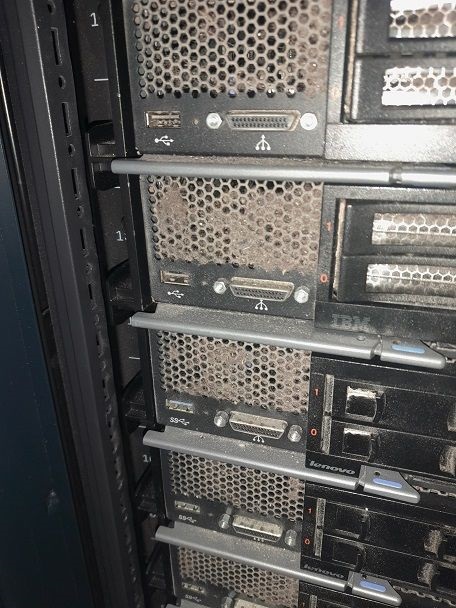
Particles sized 0.5 µm and 1.0 µm are too small for standard ACU filters to trap effectively. They move with the airflow and remain suspended in the environment — eventually settling on servers, cables, and sensors.
How Economised Air Changes the Dust Profile
When a data hall uses economised air (fresh outdoor air) for “free cooling,” it reduces chiller load and improves energy efficiency.
However, it also introduces external air laden with fine particulates such as PM2.5 and PM1.0 — generated by traffic, industrial emissions, and general pollution.
If the fresh air intake or economiser is only equipped with basic filters (e.g. G4 or M5), those submicron particles easily enter the room, bypass the ACU filters, and circulate within the data hall.
Over time, this leads to increased contamination and potential long-term reliability issues for IT equipment.
Why ACUs Can’t Handle Fine Dust Filtration
It might seem logical to simply install HEPA or F9 filters in the ACU — but it’s not that simple.
Fine filters have a much higher pressure drop, which:
- Restricts airflow and reduces cooling performance
- Increases energy use
- Risks creating hot spots around critical racks
- Exceeds the design capacity of most ACU fan motors
For this reason, fine filtration should be applied upstream, at the air handling unit (AHU) or economiser intake, not inside the ACU itself.
Best Practices for Controlling Dust in Data Halls
To keep data halls, clean and efficient without compromising airflow:
- Upgrade Economiser Filtration
- Stage 1: G4 pre-filter – captures coarse dust and debris
- Stage 2: F9 fine filter – traps 0.3–1.0 µm particles
- Seal All Filter Frames and Duct Joints to prevent bypass leaks.
- Monitor Differential Pressure to know when filters need replacement.
- Retain G4/M5 Filters within ACUs for equipment protection.
- Schedule Regular Professional Data Hall Cleaning to remove residual dust that escapes filtration.
- Install Control matting at doors like Dycem
The Role of Professional Data Hall Cleaning
Even with upgraded filtration, microscopic dust will still accumulate over time — especially on server surfaces, under raised floors, and around air outlets.
Regular, specialist data hall cleaning helps prevent dust buildup, static discharge risks, and airflow blockages.
At IT Cleaning Ltd, our trained technicians use antistatic vacuum systems and microfibre wiping techniques to safely remove contamination without downtime or disruption.
Learn more about our Data Centre Cleaning Services or contact us for a free site assessment.
In Summary
ACU filters in data halls do not filter dust at 0.5 and 1.0 micron, particularly when economised air is introduced, because:
- Standard filters are not designed for submicron dust capture
- Outside air introduces additional fine particles
- Fine filtration requires careful engineering to balance airflow and efficiency
The most effective solution combines high-efficiency filtration at the air intake with regular specialist cleaning — ensuring a cleaner, more reliable, and energy-efficient data hall.
Written by Stephen Yates Managing Director.
Experts in Data Centre and Technical Environment Cleaning
Contact | Stephen Yates